


 Youtube
 Linkedin
 Instagram
 facebook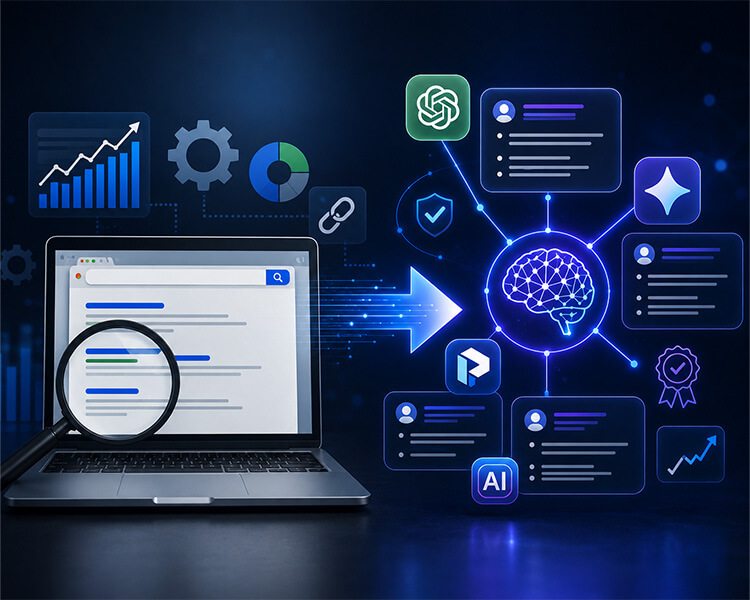
Being visible on Google is still important, but the search results page is no longer the only playing field.
For many years, the first question associated with digital visibility was:
“What position do we rank in on Google?”
That question is still relevant. In fact, for many industries, it remains one of the most important indicators of commercial success. People continue to use search engines when looking for products, services, solutions, experts, suppliers, and information.
However, it is no longer enough to explain digital visibility solely through traditional search results.
Users do not access information only through blue links anymore. AI-powered systems such as ChatGPT, Gemini, Perplexity, and Google AI Overviews have begun providing direct answers to users’ questions. Sometimes these answers direct users to websites. In other cases, they satisfy the user’s need for information directly within the results page or answer interface.
This creates a new question for brands:
Are you only visible on Google, or can you also be referenced in AI-generated answers?
SEO is not disappearing. However, a new layer is being added on top of it: GEO.
GEO stands for Generative Engine Optimization.
Put more simply, it is the effort to become visible, understandable, trustworthy, and referenceable within AI-powered answer engines.
Short Answer: What Is the Difference Between SEO and GEO?
SEO encompasses the technical, content, and authority-building efforts designed to improve a website’s visibility in search engines. GEO focuses on making a brand understandable, quotable, and recommendable within AI-powered answer systems such as ChatGPT, Gemini, Perplexity, and Google AI Overviews.
In GEO, the objective is not only to be found, but to be included within answers as a trusted source.
On GEO, the goal isn’t just to be found; it’s to be featured among the answers as a reliable source.
Why Has GEO Become Important?
The reason GEO has become a major topic is the change in user behavior. In the past, when users wanted to learn something, they would search on Google, review the results, visit several websites, compare information, and gradually reach a decision.
Today, however, users can ask the same question to an AI tool
“What should a manufacturing company in Turkey looking to expand into the German market keep in mind for its website?”
“How is trust built through B2B social media management?”
“What are the best digital marketing strategies for industrial companies?”
“What criteria matter when redesigning a corporate website?”
“What should be considered when selecting an agency?”
In the answers to these questions, certain sources, brands, concepts, and websites are cited and highlighted. Others are not visible at all.
In its 2026 GEO guide, Search Engine Land, one of the leading publications in the search marketing industry, presents the topic as a new optimization framework focused on helping brands be cited, recommended, and discovered within AI-powered search engines. The article also emphasizes that brands must now think not only about traditional search visibility, but also about how they are represented in AI search environments.
This perspective is particularly important for B2B companies.
In B2B markets, decision-makers rarely make purchases immediately. They research first. They compare options. They gather information. They read content. They try to understand alternatives. If part of that research process is now taking place through AI-powered systems, brands need to rethink their digital information architecture accordingly.
Is AI-Powered Search Behavior Really Growing?
This question requires a careful answer. Statements such as “SEO is dead” tend to spread quickly in the marketing world because they are simple and attention-grabbing. In reality, the issue is not that SEO is disappearing, but that search behavior is becoming more layered.
In its analysis of AI-powered search and customer journeys, global management consulting firm Bain & Company reports that 44% of online buyers in the United States either begin their journey primarily within an LLM environment or use AI tools alongside traditional search. Bain’s findings indicate that the customer discovery process is no longer driven exclusively by traditional search engines.
This finding is particularly important for content, SEO, and web strategy.
When the customer journey changes, a brand’s digital touchpoints must evolve as well.
At one time, the primary question was:
“How do we rank higher on Google?”
Today, new questions are being added:
Does AI understand our brand correctly?
Are our services explained clearly enough on our website?
Is our content structured in a way that supports answer generation?
Can our case studies be used as reference material?
Do our FAQs address real user questions?
Is our brand information consistent across different platforms?
Has our expertise been sufficiently demonstrated online?
These questions do not replace SEO. They expand the scope of SEO.
AI Overviews and the Reality of Zero-Click Searches
Another reason GEO is becoming more important is that AI-generated summaries are changing click behavior.
Pew Research Center, a respected research organization that publishes studies on society, media, and digital behavior, analyzed data from March 2025 and found that users who see AI summaries on Google are less likely to click on traditional search results. According to the study, the click-through rate to traditional search result links was 8% when users were shown an AI summary, compared to approximately 15% when no AI summary was displayed.
Ahrefs, known for its SEO tools and search data analysis, has also reported significant declines in organic click-through rates related to the impact of AI Overviews. In its February 2026 update, Ahrefs stated that, as of December 2025, content ranking in the first position experienced a 58% decline in organic click-through rates for queries that displayed AI Overviews.
These findings suggest the following:
If users receive the answer directly within the search results page or an AI-generated summary, the need to visit a website may decrease.
This does not mean that websites are becoming less important.
On the contrary, the role of the website is changing.
A website should be designed not only to attract clicks, but also to function as an information hub that answer engines can understand and trust as a reliable source.
In other words, the objective is not simply to generate traffic. The objective is to make a brand’s digital information assets clearer, more trustworthy, and more referenceable.
Is SEO Ending? No. SEO is not ending. However, relying solely on traditional SEO practices may gradually become insufficient.
SEO remains important:
Google remains a major discovery channel.
Users still search for products and services.
Website traffic remains valuable.
Technical SEO is still necessary for visibility.
High-quality content still demonstrates expertise.
Backlinks, authority, and brand mentions still matter.
However, SEO should now be viewed as part of a broader visibility strategy.
Today, brands are discovered not only through search engine results pages, but also through AI-generated answers, social platforms, video search, professional networks, and niche communities.
For this reason, it is not helpful to position SEO and GEO as competing concepts.
A more relevant question is:
Is our SEO foundation strong enough to support our GEO visibility as well?
How Should a Website Be Structured for GEO?
From a GEO perspective, a strong website should be structured in a way that allows AI systems to more easily understand the brand, its services, areas of expertise, target audience, and supporting evidence.
This is not solely a technical exercise. Content strategy, information architecture, trust signals, and brand clarity must be considered together.
1. Service Pages Must Be Clear
On many websites, service pages are written in overly general terms.
“We provide digital solutions.”
“We add value to your brand.”
“We offer 360-degree services.”
These statements may sound appealing, but they are not sufficiently descriptive for either users or AI systems.
A clear service page should answer the following questions:
What exactly is this service?
Who is it intended for?
What problem does it solve?
How does the process work?
What deliverables are provided?
How is success measured?
What should a client expect from this service?
This structure strengthens the user experience while also making it easier for answer engines to understand the content.
2. FAQs Should Be Based on Real Questions
FAQ sections are highly valuable from a GEO perspective because AI systems can process clear, structured, and contextual question-and-answer content more effectively.
However, the critical point is this:
FAQs should be based on questions that users actually ask.
Rather than relying on standard questions such as “How can you contact us?”, the content should address the real questions that decision-makers have in mind.
For example: How long does a B2B website redesign project take?
What is the difference between a corporate website and a landing page?
How long does it take for SEO efforts to produce results?
How does a LinkedIn content strategy contribute to B2B sales?
Why is localization important for a company entering a new market?
Yapay zekâ cevaplarında görünür olmak için blog içerikleri nasıl hazırlanmalıdır?
These questions create valuable content opportunities for both SEO and GEO.
3. Case Studies Should Be Strengthened
When evaluating brands, AI systems need more than a list of services. They also need evidence of what the company has actually done.
This is why case studies are becoming increasingly important.
A strong case study should include the following elements:
The client’s challenge
The starting situation
The strategic approach
The implementation process
The deliverables produced
The lessons learned
Key takeaways for similar companies
This structure provides clearer signals about a brand’s expertise not only to human readers, but also to AI systems.
Displaying logos on a “Our References” page is a starting point. In the GEO era, however, explaining what was solved and how it was solved is far more valuable.
4. Blog Content Should Be In-Depth and Answer-Focused
The value of short, superficial, and repetitive blog content is declining. GEO-friendly blog content does not simply target keywords. It genuinely explains a topic, answers related questions, defines concepts, provides example scenarios, and contributes to the reader’s decision-making journey.
A strong blog article should include the following characteristics:
A clearly defined primary topic
Clear definitions
A structure organized with subheadings
A question-and-answer framework
Claims supported by sources
Localized insights
Takeaways relevant to decision-makers
Up-to-date information
A frequently asked questions section
This structure creates content that is more valuable for search engines, answer engines, and human readers alike.
5. Brand Information Must Be Consistent
From a GEO perspective, not only the website but also the brand’s broader digital ecosystem matters.
The company name, service descriptions, industry focus, address, social media profiles, LinkedIn description, Google Business profile, news coverage, interviews, press releases, and information published by third-party sources should all be consistent.
If a brand presents itself differently across multiple platforms, AI systems may struggle to develop a clear understanding of the business.
For this reason, GEO is not simply about publishing blog content.
It is about organizing and managing a brand’s digital footprint.
Why Is GEO More Critical for B2B Brands?
GEO is becoming increasingly important across all industries. However, it carries particular significance for B2B companies.
This is because the B2B buying journey is generally information-driven.
Decision-makers do not immediately purchase a product or service. They conduct research first. They explore alternatives. They try to understand risks. They consume content. They review expert opinions. They seek the most reliable option for their organization.
As AI-powered answer systems play a greater role in this research process, B2B brands must ensure that their digital content is clearer, more trustworthy, and more structured.
When a manufacturing company wants to enter export markets, when a healthcare clinic seeks a digital strategy for international patient acquisition, when a software company researches how to position itself in the enterprise market, or when an industrial brand wants to establish a dealer network, decision-makers may no longer rely solely on Google search results.
They may ask AI systems questions such as:
“Which digital channels are most effective for B2B lead generation?”
“How should industrial companies use LinkedIn?”
“What should a website look like for a company targeting export markets?”
“How should a trust-building website for corporate services be developed?”
“What criteria should be considered when selecting a digital agency?”
Being included in the answers to these questions represents a new visibility opportunity for brands.
However, this visibility does not happen by chance.
A website and its content ecosystem must provide sufficient information, clarity, consistency, and authority.
What Should Be Considered When Creating Content for GEO?
Producing GEO-friendly content requires a more disciplined approach than writing traditional SEO content.
1. Define the Topic
Every article should clearly define the concept it addresses.
For example:
What is GEO?
What is B2B SEO?
What is digital trust?
What is localization?
What is thought leadership?
AI systems favor clear definitions. Human readers do as well.
2. Anticipate Questions
The related questions users may ask about a topic should be identified in advance. An article should not focus solely on a single keyword. It should address the broader universe of questions surrounding that topic.
3. Present Both Short and Long-Form Answers
A useful GEO approach is:
Provide a short answer first.
Then provide a detailed explanation.
This structure allows users to understand the key point quickly while also creating content that is easier for answer engines to process.
4. Use Sources Naturally
Sources should not be listed randomly at the end of an article. When making a claim, the relevant source should be introduced within the content itself.
For example:
“One of the leading publications in the search marketing industry, Search Engine Land…”
“Global management consulting firm Bain & Company…”
“Pew Research Center, known for its research on society and media behavior…”
This approach also helps readers understand why a source is credible and relevant.
5. Add Localized Interpretation
Simply translating international reports is not enough. Each finding should be interpreted within the context of the local market and target audience.
For example, AI search may be growing rapidly in the United States. However, it would be premature to assume that adoption in Türkiye is occurring at exactly the same pace or in the same way. At the same time, it would be a mistake to ignore the broader shift in user behavior.
A healthy approach is:
Understand the global trend accurately.
Adapt it to the local market without exaggeration.
Connect it to the brand’s own strategy.
How Is GEO Success Measured?
GEO does not yet have metrics that are as mature or standardized as those used in SEO. However, several indicators can be monitored.
Are searches for the brand name increasing?
Is the brand being mentioned in ChatGPT, Perplexity, or AI Overviews?
For which topics is the brand being referenced?
How are organic traffic sources changing?
Is blog content generating more qualified leads?
Are FAQ pages gaining greater visibility?
Is interest in case study pages increasing?
Are decision-makers referring to website content during conversations?
Is there more interaction between LinkedIn and the website?
GEO should not be measured solely through clicks.
Visibility within AI-generated answers may not always produce direct clicks. However, it can influence brand awareness, trust perception, and preference.
For this reason, GEO should be viewed less as a short-term traffic metric and more as a long-term digital authority initiative.
Why Is the Website Becoming More Valuable in the GEO Era?
At first glance, the growth of AI-generated answers may seem to reduce the importance of websites. If users receive answers directly from AI systems, why would they need a website?
This perspective is incomplete.
AI systems require high-quality sources in order to generate accurate, trustworthy, and contextual answers. Your website can be one of those sources.
However, for this to happen, a website must be strong not only visually, but also in terms of content.
In the GEO era, the website becomes:
The primary information hub for the brand.
The place where services are clearly defined.
The place where expertise-driven content is consolidated.
The place where case studies are presented.
The place where questions are answered through FAQ structures.
A source of trust signals for both search engines and answer engines.
A source of evidence for decision-makers conducting pre-sales research.
In other words, the website does not become less important.
It becomes more strategic.
SEO-to-GEO Transition Checklist
If a brand is considering the transition from SEO to GEO, it can start with the following checklist:
Are our service pages clear?
Do we answer the questions “What is it?”, “Who is it for?”, and “What problem does it solve?” for each service?
Is our blog content superficial, or does it genuinely explain topics in depth?
Are our FAQs based on the real questions decision-makers ask?
Are our case studies sufficiently clear?
Is our brand information consistent across our website, LinkedIn, Google, and other platforms?
Is our content supported by credible sources?
Do our articles follow a structure that combines a short answer with a detailed explanation?
Are we localizing content according to the language and expectations of our target market and audience?
Do we regularly review how our brand appears in AI-powered tools?
The answers to these questions provide a clear indication of a brand’s level of GEO readiness.
The UIM Perspective: Being Found Is Not Enough, You Must Be Referenceable
From UIM’s perspective, the transition from SEO to GEO is not simply a technical trend. It demonstrates the need to consider websites, content, brand trust, and digital growth systems as interconnected elements.
In the age of AI, visibility is not achieved through keywords alone.
It requires clear positioning.
It requires strong content.
It requires consistent brand data.
It requires compelling case studies.
It requires FAQ structures that answer real questions.
It requires blog content that demonstrates expertise.
It requires a website that is technically and content-wise sound.
For this reason, GEO should not be approached as simply “writing a few AI-friendly articles.”
The real objective is to strengthen the brand’s digital information architecture.
When a decision-maker or an AI-powered system researches your brand, the following picture should emerge:
What you do is clear.
What you do is clear.
Who you serve is clear.
The problems you solve are clearly defined.
Your expertise is supported by content.
Your references are validated.
Questions have been answered.
Your brand data is consistent.
Your digital touchpoints inspire trust.
When this structure is in place, both SEO and GEO become stronger.
Conclusion: SEO Is Not Ending, Visibility Is Expanding
It is easy to say that SEO is dead, but that is not accurate.
A more accurate statement is:
SEO is becoming part of a broader digital visibility strategy.
Traditional search results remain important. However, AI-powered answer systems are changing the way users access information. Search Engine Land’s positioning of GEO as a framework for being cited, recommended, and discovered within AI-powered search engines, Bain’s findings that a significant share of online buyers now use LLMs or AI tools during their research journey, and the findings from Pew and Ahrefs showing that AI-generated summaries can influence click behavior all demonstrate that this shift should be taken seriously.
For B2B brands, the core message is clear:
Being found is no longer enough.
You must be referenceable.
Achieving that requires websites, content, case studies, FAQ structures, technical infrastructure, and brand data to be considered together.
GEO is not a buzzword intended to replace SEO.
When approached correctly, GEO becomes a new strategic layer that helps a brand become clearer, more trustworthy, and easier to understand in the digital environment.
Frequently Asked Questions
GEO stands for Generative Engine Optimization. It can be understood as optimization for AI-powered answer engines. The goal is to make a brand more understandable, trustworthy, quotable, and recommendable within systems such as ChatGPT, Gemini, Perplexity, and Google AI Overviews.
SEO encompasses the efforts made to improve a website’s visibility within traditional search engines. GEO focuses on helping AI-powered answer systems better understand a brand, its services, and its content. While rankings and clicks are central to SEO, GEO places greater emphasis on being cited and referenced within generated answers.
A GEO-ready website should include clear service pages, strong FAQ sections, detailed blog content, case studies, consistent brand information, and clear definitions. Content should be developed not only around keywords but also around answering real user questions. Technical SEO, content architecture, and trust signals should be addressed together.
Users no longer rely exclusively on traditional search results to access information. Systems such as ChatGPT, Gemini, Perplexity, and Google AI Overviews are increasingly becoming part of the research process. If your brand appears as a trusted source within these answers, it can establish credibility with decision-makers at a much earlier stage of their journey.
GEO kısa vadeli bir reklam kampanyası gibi düşünülmemelidir. Daha çok markanın dijital bilgi mimarisini, içerik kalitesini, web sitesi yapısını ve güven sinyallerini güçlendiren uzun vadeli bir çalışmadır. Net hizmet sayfaları, derin blog içerikleri, FAQ yapıları ve vaka anlatıları zaman içinde markanın hem SEO hem GEO görünürlüğünü destekler.
Sources Referenced
This article is based on Search Engine Land’s 2026 GEO guide, Bain & Company’s analysis of AI-powered customer journeys, Pew Research Center’s research on Google AI summaries, and Ahrefs’ data regarding the impact of AI Overviews on click behavior. Search Engine Land is a specialist publication focused on search marketing and SEO. Bain & Company is a global management consulting firm. Pew Research Center is an independent research organization that publishes studies on digital behavior, media, and society. Ahrefs is an international SEO platform known for its SEO tools and search data analysis capabilities.